Tag Archive for: customer service consultant

customer service expert“Are your customers better off having known you?”  This is a question we ask in our Proactive Service® workshops – a workshop for technicians to help them understand and develop the skills and approaches to engage their customers in business development activities.   Our point to the technicians is that, if they want to add real value to their customer relationships, they must do more than simply do a good job at maintenance and service, while reactively addressing any problems that arise.  Any tech can do that and most do.  The real value comes from getting to know the needs of the customer and using their accumulated knowledge and expertise to make recommendations about what they can do to help the customer achieve them.  The measure of their success is whether the customer can say they are better off.

As managers, we have an important role to play here.  Our technicians must understand that this is an integral part of their role.   They must recognize that these proactive conversations that they have with their customers represent a valuable and important service – as important as fixing and maintaining the customer’s equipment.  We must ensure that the processes, systems and expectations of all customer-facing personnel support the technicians’ efforts.  We must be prepared to provide training on the necessary skills for our technicians to be successful and coach on and support those skills regularly.  And, we must maintain focus on this initiative consistently, month after month and take every opportunity to do so through toolbox, safety and other service related meetings. Read more

customer service expertI was reminded this morning that it doesn’t take much for a service provider to stand out from the crowd.  There is a lot of focus on enhancing the customer experience and creating strong relationships that clearly differentiate you from your competition.  My experience with my mobile service provider was a perfect case in point.

I woke up this morning to a problem.  I could not send or receive emails from my smart phone.  It seems that they were wiped out over the weekend when I was dealing with a completely unrelated problem.  To set them up, I needed to know my user name and password.  The ones I thought were correct turned out to be incorrect.  Each time I tried it, the counter on my smartphone told me that I had only 6 tries left, then 5 tries, then 4.

On a normal day, this would be an inconvenience but this morning it was catastrophic (at least for me).  It was 4:45 am and I was rushing to get to the airport for an early morning flight.  We had a snowstorm overnight leaving the roads a mess and easily doubling the travel time.  I would be away for a few days and my cell phone was my only link to my business during the day.  I had to get this problem fixed quickly.  I could feel the stress.

I called the carrier without much hope of getting anyone live at that time in the morning and, to my relief, I got through to a customer service representative.  I explained the problem I was experiencing and he pointed out that I did not have an account and I would need to set one up.  He explained how to go about it, gave me some helpful advice on selecting a User I.D., and waited on the phone while I completed the instructions. He then happily continued to stay on the line while I set up my emails, although he certainly did not have to.  When I told him I appreciated his support he replied that he knew I was anxious about the situation and he wanted to ensure that everything went smoothly and should there be a glitch, he would be there to help me out.

Now, in the scheme of things, I guess you could say that the customer service representative was just doing his job.  And maybe, he had nothing better to do at that time in the morning – I don’t suppose he would have been run off his feet.  However, the willingness to stay on the line and guide me through the steps until everything was working the way I needed it was the best thing he could have done for me this morning.  It showed that he was sensitive to my situation (please read this prior blog post on empathy) and he provided the level of support he felt would suit my needs in the circumstances.

It seems to me that this is something exceptional field service technicians do as a matter of course.  They stay around a few extra minutes to ensure that the problem that was repaired was done so correctly.  They follow-up on recent work to make certain the customer is happy.  They understand and show empathy for the customer’s situation by acting in a way that best suits the customer’s needs given the circumstances.  This isn’t much, but technicians who practice these small extra steps, certainly stand out from their peers.  And, so do the companies they represent.

I’d love your feedback. And as always, please feel free to leave a link back to your own blog if you have one via the commentluv feature here on the site. If you are reading this blog post via email, you will need to locate this post on my website by clicking here. Scroll down to the bottom of the page where you will find the comment section.

Jim

“Service to others is the rent you pay for your room here on earth.”

– Muhammad Ali

 

customer service expert“Money isn’t everything, … but it’s way ahead of whatever is in second place!” is a quote that is connected to some of the happiest times of my life.  Little did I know at the time that, with a slight modification of a single word, it could hold an important message for service companies.

As a kid growing up in southern Ontario, we used to spend a week each summer at my Uncle’s cottage on a lake a couple of hours north east of our home in Toronto.  My cousin and I would spend the days swimming, fishing, canoeing or just aimlessly lazing around.  Evenings were campfires and mosquitos.

On the shore was a boathouse and above it a living quarters that was used mainly for storage during those days.  It was the perfect place for kids to just hang out.  The walls were dotted with little plaques with witty sayings.  I do not know who originally penned this particular one, but it seems to have stuck with me.

There is a lot of talk these days about the customer experience and how it is critical to creating today’s competitive advantage.  In the service industry, the customer experience is largely created by the interaction of our customer-facing personnel with the customer.  In most cases our “customer-facing personnel” are our technicians and the customer experience comes from the relationships they are able to form.  It is these relationships, built on both personal and professional credibility that are critical for our success.

In the service business there are two components – one is the actual work that was completed (the repair, maintenance, troubleshooting, etc. – why the customer called us in the first place) and how that work was performed and described (the technician’s appearance, how they act and interact with employees, what they write to describe the work, etc.).  This fact is described in more detail in a previous blog “They don’t Pay Me to Look Good in Service Delivery”. It is the second component – the how the work was performed – that customers used to judge the quality of the work and the quality of the relationship.  And it is that relationship that creates the customer experience.  This means that, regardless of how technically skilled our technicians may be and no matter how good the work itself has been performed, the customer will not appreciate this quality nor the value that the technician brings to them unless the technician has a relationship with them that communicates that value.  Without the relationship and the corresponding value they perceive, the customer will look elsewhere to find better value.  Or, would it be better to say that in the service business:   “Relationship isn’t everything, … but it is way ahead of whatever is in second place!”

I’d love your feedback on this. And as always, please feel free to leave a link back to your own blog if you have one via the commentluv feature here on the site. If you are reading this blog post via email, you will need to locate this post on my website by clicking here. Scroll down to the bottom of the page where you will find the comment section.

Jim

“If you want to feel rich, just count the things you have that money can’t buy.”

– Proverb

customer service tech training expertI received an important reminder about giving customers our hearts as well and our heads.  I was having lunch with a good friend and client last week and we got onto the topic of the benefits and pitfalls of engaging technicians in business development activities.  In particularly we were talking about how sales people can use the proactive promotion of services by their technicians to differentiate themselves when selling contract services.  I mentioned that while most companies give their customers their hands (i.e. do good work), proactive service companies provide customers with their heads as well.  By looking out for their customers and making helpful suggestions to allow them to be more effective at operating their facilities, they are providing the highest level of service.

Steve, who is a key part of a large, national service firm suggested, “Actually Jim, I agree with you but I think you need to be more specific.  When engaging our service technicians in speaking to customers about the other things we can do to assist them, we need to ensure that they use their hearts as well as their heads.”  Steve went on to relate a story that a service manager told him.  It seems that they had a technician on staff who took promoting services to a new high.  He would promote anything and everything to anybody that would listen.  As a result, this service manager was getting complaints from several customers.  They didn’t appreciate being “sold” when the technician was really there to service their equipment.  Steve went on, “This technician wasn’t really acting on behalf of the customer, he was acting for himself and the benefits that he would get if the customer bought the product or service he was offering.  His heart was not in the right place and the customers could spot it a mile away.”

Steve was right.  Technicians have to engage the customer in these kinds of discussions for the right reasons.  They have to believe that the customer will be better off by taking their recommendations.  If they don’t believe that the recommended action is in the interest of the customer, then they should not be suggesting the service at all.  That is one of the reasons I don’t think that “commissions” or “bonuses” should be paid for services sold by the technician.  It encourages the behaviour but for the wrong reasons.

I encourage you to look closely at your own programs for promoting services through your technicians.  Are your technicians empowered to give your customers their hearts as well as their hands?  Do your support systems (like bonuses or commissions) reinforce this approach or do they encourage them to leave their hearts in the truck?  Have you made it clear that you want them to use good judgement before making recommendations and be certain, in their own minds, that the recommendation is truly in the interests of the customer?

I’d love your feedback on this. And as always, please feel free to leave a link back to your own blog if you have one via the commentluv feature here on the site. If you are reading this blog post via email, you will need to locate this post on my website by clicking here. Scroll down to the bottom of the page where you will find the comment section.

Jim

“A good head and a good heart are always a formidable combination.”

– Nelson Mandela

Jim Baston Customer service expertIn step 5 of our previous blog, we talked about following up on opportunities. The 6th and final step in creating a Proactive Service® culture within your service team is to provide coaching and support.  If we want to see results, we must create an environment that fosters learning and encourages the desired behaviour.

It is important to keep in mind that, as managers, we are not measured so much by what we do, but by what our employees do.  That means that we should be trying to spend as much of our time as possible in helping our employees do their jobs better.  However, the reality is that we are in a fast-paced, real-time business that often forces us to put coaching and development activities aside to address more urgent matters.  When we allow this to happen too often, we find we spend little or no time providing the critical support that will truly help our employees excel.  And that can be costly in terms of our team’s effectiveness and therefore our overall performance.  Some research has demonstrated that with new skills adoption, as much as 75% of an initiative’s success will be dependent upon the actions of management to support and coach their employees.  A large association of training and development professionals found that training, followed by coaching, showed a four-fold improvement in skills adoption. Read more

Jim Baston service manager trainingThe fourth step in creating a Proactive Service® culture for your field service team is to ensure that there is a clear and consistent process for handling opportunities from the field.  Without a clear process, we leave the follow-up largely to chance and create the potential for frustration and resentment on the part of our technicians and customers.
Nothing will stop a technician from making recommendations to a customer more quickly than poor or inconsistent follow-up by the rest of the company’s staff.  A technician that makes a recommendation that requires follow-up by others (salesperson or manager for example) and which is not followed up, is unlikely to continue to do so.  But worse than that, lack of follow-up can have serious consequences.

I worked with one service firm that did not have a formal process for handling opportunities from the field.  I interviewed one of their technicians and he related a story that highlights the problems that can occur.  The technician had found a problem with a key piece of equipment and recommended to the customer that it be replaced as soon as possible.  The customer asked the technician to have someone get in touch with him with pricing and installation information for the replacement.  The technician reported the opportunity on the work order along with the request for a follow-up call by the salesperson responsible for the account.  Unknown to the service tech, the information did not get to the salesperson and no one followed up.  About a month later, the customer called in a panic because the equipment failed, just as foretold.  Rather than praising the technician for his ability to predict the failure, the customer was furious that there was no follow-up on the part of the firm.  The service technician took the brunt of the customer’s anger and felt let down by his colleagues.  Needless to say, by the time we spoke to the technician, he was reluctant to identify opportunities in the future.

Even when a process for opportunity management is in place, it may not include an important step.  One of the most common complaints we hear from technicians is that, even when there is follow-up, the technician is not kept in the loop.  The lack of a communication loop to keep the technician informed causes more than hard feelings.  It also can cause a customer service failure.  Let’s assume that the technician has spoken to the customer and they are interested in pursuing an idea that she brought forward that may reduce energy consumption.  The salesperson or manager is duly informed and goes out to visit the customer.  If there is no communication back to the technician, the salesperson may develop a solution that is beyond what the technician had in mind and far exceeds the customer’s expectations.  A simple discussion with the technician would have prevented this from happening and the technician would have an opportunity to share her ideas with the salesperson that could be incorporated into the ultimate solution.  In addition, by keeping the technician in the loop, the technician will have an informed response if the customer asks about the progress on the opportunity development the next time she is in their facility.

A key step therefore, to ensure that you create a successful and lasting Proactive Service® culture is to ensure that you have a clear, concise and consistent process for identifying and following-up on recommendations from the field.  Not only will this improve your service delivery, but it will let your technicians (and customers) know that these recommendations are important and that they play a key role in your firm’s the overall service delivery.

I’d love your feedback! And as always, please feel free to leave a link back to your own blog if you have one via the commentluv feature here on the site. If you are reading this blog post via email, you will need to locate this post on my website by clicking here. Scroll down to the bottom of the page where you will find the comment section.

Jim

“Efficiency is doing things right; effectiveness is doing the right things.”

– Peter Drucker


Jim Baston service expertIf you are interested in creating a proactive service® focus for your field service technicians, the first step is to focus on the service, not the sale.  This is more than just semantics, it is a mindset that deals with the very heart of what we want our technicians to do.

Technicians who seem naturally gifted at selling their company’s products or services do not see their efforts as selling at all – they recognize their recommendations as the valuable service that they are.  To them it is a service activity. Read more

customer service expert CanadaThink that your employees are empowered to deliver an exceptional customer experience?  Don’t bank on it.  Your policies may be letting you down. I learned this lesson recently during a trip to a bank. It was a Saturday afternoon and I was off to the UK on business on an early morning flight on Monday.  To my dismay, I realized that I did not have any British currency.  No problem, I reasoned, I just need to go to the bank.
As it turned out, my branch was closed by the time I arrived.  Fortunately, another bank on the other side of the plaza was open.  By coincidence, I used to have all of my accounts with the open bank until about three years ago and I still had a Visa card with their name on it.

I waited my turn for the lone teller.  When I got to the wicket, I explained that I would like to purchase some pounds sterling.

Certainly sir, how much would you like?” came the very pleasant reply.

£200 should do it, thanks.”

No problem, just put your bank card in the slot.” she directed.

Read more

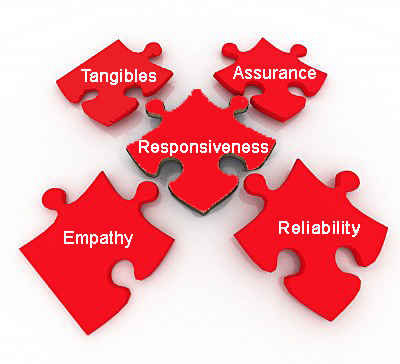
customer service expertIn this blog, we will consider what we can do to transform the service experience by demonstrating our responsiveness.  Responsiveness shows our competence and this creates Assurance. Responsiveness shows that we are Reliable and demonstrates that we have Empathy for our customers.

Recall that the name RATER[1] is an acronym with each letter representing the first letter of one of the five key dimensions of service quality.  They are:

R eliability: Our ability to provide what is promised, dependably and accurately

A ssurance: Our knowledge and courtesy, and our ability to convey trust and confidence

T angibles:  Our physical facilities and equipment, and our appearance

E mpathy:    The degree of caring and individual attention we provide to customers

Responsiveness:  Our willingness to help customers and provide prompt service

To demonstrate responsiveness, consider what your team can do to demonstrate responsiveness through every customer touch point.  For example, does everyone on your team know that responsiveness means being accessible?  Do they understand the importance of getting back to the customer in a reasonable amount of time?  Are they aware of what accounts for “reasonable” when getting back to customers, colleagues and suppliers?

Read more

customer service expertIn my last post on the five key dimensions of service quality, we considered what we can do to transform the service experience through the tangible aspects of the service we provide. Here we consider what we can do to transform the service experience by clearly communicating to our customers that we care about them.  Our customers will have little regard for us until they know that we have empathy.

Recall that the name RATER is an acronym with each letter representing the first letter of one of the five key dimensions of service quality.  They are:

R eliability: Our ability to provide what is promised, dependably and accurately

A ssurance: Our knowledge and courtesy, and our ability to convey trust and confidence

T angibles:  Our physical facilities and equipment, and our appearance

E mpathy: The degree of caring and individual attention we provide to customers

R esponsiveness: Our willingness to help customers and provide prompt service

Read more