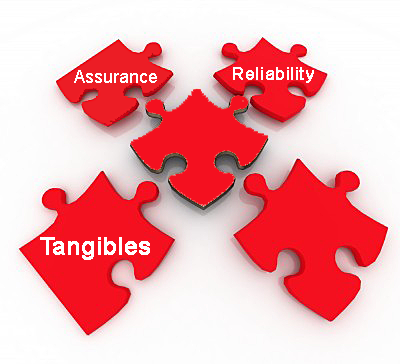
 In my previous blog in this series, we discussed how to transform the service experience through ‘assurance’. In this blog post, we will consider what we can do to transform the service experience through the tangible aspects of the service we provide. Our customers will make judgments about the quality of our work and the competence of our technicians based on tangible clues that they can see.
Recall that the name RATER[1] is an acronym with each letter representing the first letter of one of the five key dimensions of service quality. They are:
R eliability: Our ability to provide what is promised, dependably and accurately
A ssurance: Our knowledge and courtesy, and our ability to convey trust and confidence
T angibles: Our physical facilities and equipment, and our appearance
E mpathy: The degree of caring and individual attention we provide to customers
R esponsiveness: Our willingness to help customers and provide prompt service
 If you want to transform the service experience you create for your customers to one that is valued and enables you to stand out from your competitors, then this will be of interest to you. In this blog we are going to look at the 5 dimensions of service quality and examine how you can use them to define exactly the service experience you want to deliver.