Tag Archive for: Jim Baston

33078655 - 3d white people team assemble three piece of a puzzle

I meet service leaders everyday who encourage their field service teams to make proactive recommendations to their customers of products and services that will help those customers to be better off.  The vast majority of those I speak to however, do not tell their customers they are asking their field service team to do this.  That’s a pity.  Proactive recommendations by your field team are a big business differentiator.

Why Don’t More Service Firms Promote Their Field Team’s Efforts?

Before we look at the how, let’s consider the why.  It is interesting to note that most firms in my unscientific sampling do not let their customers know that they have encouraged their field service professionals to look for and make recommendations to help them be better off.  This is true, even though the efforts of the field service team can add tremendous value.  By taking proactive steps, the field service team can help your customers reduce costs, improve asset life, increase productivity and numerous other benefits.

If this is true, then, why don’t more firms tell their customers what their field team is up to?  Perhaps it is because these organizations do not feel that the customer will appreciate the real value of these proactive efforts by their field service team.  They may be right.  Unless customers are educated about the value, they may not recognize the significant impact these proactive efforts can have on their ability to achieve their own business goals.

Therefore, one of the important steps that management must take is to inform the customer of this value and use it as an important differentiator in a market that is getting increasingly competitive.  Here’s how.

1. Tell the Customer What You Are Doing

The first step is to tell the customer what you are doing and why it is of benefit to them.  Point out that your field team is in a unique position to recognize actions that the customer can take to help them achieve their business goals.  They understand the technology, they can see how the customer is applying it and they understand their own firm’s capabilities.

2. Ask the Customer for Their Permission

Once you tell the customer what you are doing, it opens up the opportunity for the customer to give you permission to engage them in this way.

The conversation might go like this.  “Mr. or Ms. Customer, as you may appreciate, our field service team includes some of the finest technical minds in this industry.  We have encouraged them to use their knowledge and expertise to look for ways that our customers can do things better and help them achieve their business goals.  We have asked our field team to proactively speak to our customers about their recommendations.  If during the course of our work for you our field service professional identifies something that they feel would be of significant benefit to you, would you have any objection if they brought it to your attention?”

3. Use the Proactive Efforts of Your Field Team to Sell New Service Contracts

Work with your sales team to create your unique selling proposition that clearly sets you apart from your competitors.  Obviously it will take some thought and it will include the unique capabilities of your organization, but it will likely cover the fact that the customer can expect that not only will their equipment be running really well during the contract, but they should expect to be presented with ideas that will help them to be better off.  Arm your sales team with case studies and testimonials.  Now your sales team will have something tangible to present to the prospect that differentiates you from your competitors.

The highest level of service we can provide is when the customer can confidently claim that they are better off for having known us.  Help your customers see the value of the proactive efforts of your field service team and use this to differentiate your business from your competitors.  These three steps will help.

As always, I welcome your comments and questions. You can connect with me via telephone or email or leave a comment right here on the site. And as always, please feel free to leave a link back to your own blog if you have one via the commentluv feature here on the site. If you are reading this blog post via email, you will need to locate this post on my website by clicking here. Scroll down to the bottom of the page where you will find the comment section.

Jim Baston

Intellectuals solve problems, geniuses prevent them.”

– Albert Einstein

15405896 - two 3d people are shaking hands

There is a lot of interest in teaching field service technicians to promote services.  This makes sense as the field service professional is in the best position to recognize opportunities and to discuss these with their customers.  To help them, many firms look to courses to train their field teams how to sell.  But, if you’re serious about engaging your technicians in product and service promotion as part of your strategy to enhance service levels, then building personal and professional credibility are the most important skills needed for proactive service teams.

Remember That They Are NOT Salespeople

Regardless of how proactive you want your technicians to be, it is important to remember that they are not salespeople and, in the interests of your business success, you don’t want them to be.  You want your customers to see them as trusted advisors who are using their expertise to help them achieve their business goals.  The most important skills they need are the abilities to communicate their personal and professional credibility to the customer.

Establishing Trust Between Field Service Professionals and Customers

Field service professionals who are recognized as skilled in promoting services know how important it is that the customer trusts them.  That trust must be in their personal motives (trusting that they are making recommendations in the interest of the customer and not their own) and their professional competence (they know what they are talking about).

These successful field engineers understand that their personal and professional credibility is earned over time by the way they interact with their customers.  They take steps to build their credibility through every customer interaction, regardless of how insignificant it might seem.

Understanding Good Communication Skills

Their success in promoting services is not because they are polished sales professionals, but because customers trust their motives and their judgment and are willing to listen to them and take action.  Understanding good communication skills helps of course.

The ability to present a recommendation to the customer in a way that communicates the benefits of taking action from the customer’s perspective helps the customer see the value in taking action.  The skill of exploring hesitation can help customers make informed decisions and avoid problems.  But, if your technicians do not have personal and professional credibility with the customer, they won’t be successful in promoting services, regardless of how helpful the recommendation is or how skilled they are in promoting it.

So, if you really want your technicians to enthusiastically embrace your strategy to engage them in business development, focus on teaching them how to build credibility with the customer.  Ensure that they know that they are not selling, but rather providing a valuable service to the customer.  Then provide them with some basic approaches to communicate the benefits of their recommendations effectively so that the customer can make an informed decision.

As always, I welcome your comments and questions. You can connect with me via telephone or email or leave a comment right here on the site. And as always, please feel free to leave a link back to your own blog if you have one via the commentluv feature here on the site. If you are reading this blog post via email, you will need to locate this post on my website by clicking here. Scroll down to the bottom of the page where you will find the comment section.

Jim Baston

“Earn trust, earn trust, earn trust. Then you can worry about the rest.”

– Seth Godin

time management

You believe that you can offer a better service by getting your field service team to make recommendations aimed at helping your customers to be better off.  You have taken steps to support your expectations of a more proactive approach by your techs, including providing training and putting in place a process to capture leads and communicate progress on all opportunities.  However, you are disappointed that more techs have not fully embraced this strategy and time is not a luxury you have to devote to this problem.

If this sounds like you, then here are five steps that you can take to changing to a proactive business development culture when time is a limiting factor.

Don’t Stop Talking

Take every opportunity to speak about the proactive business development by technicians’ initiative and how it benefits customers.  Start and end every meeting by mentioning the strategy and tying it back to the topic at hand.

Remind your technicians that you have taken this approach because, when they use their knowledge and expertise to make recommendations that will help their customers achieve their business goals, they are providing a higher level of service.  Use every interaction as an opportunity to reinforce the value that they bring by taking this initiative.  Don’t stop talking.

Watch Your Language

People take important clues from the words that we use so it is critical that we use language that focuses on the service we are providing through the proactive efforts of our techs.  Avoid words like selling or promoting and focus every conversation on the subject on how it helps the customer.

Remember that you are offering a service by engaging your technicians in business development efforts.  Your reward comes when the customer recognizes the value in the technicians’ recommendations and rewards you with more work and greater loyalty.   Use words that communicate service.  Watch your language.

Become a Super Model

Our employees look to our actions to determine if we really mean what we say.  For example, if you are encouraging everyone to pitch in and go the extra mile, but show up each morning after 10:00 AM and leave by 2:00 PM with your golf clubs clearly visible in the back of the car, your message will have little, if any, effect.

Show your techs that you’re serious.  Talk about how previous recommendations have helped customers.  Step in quickly when there is a failure in the process or someone else in the organization doesn’t do their part.  Go out and see customers and let them know what you have asked your techs to do and why.  Become a super model.

Blow Your Techs’ Horn

When a technician makes a recommendation that the customer acts on, let everybody on the team know.  Tell them what the tech recommended and why.  Discuss how this will directly benefit the customer.  Make sure that everyone knows how this recommendation directly contributed to your customer’s well-being.  Blow you techs’ horn.

Have a Back Up Plan

Not everyone on your team will feel comfortable – at least at first – in engaging the customer in conversations about recommendations to help them to be better off.  If you have members on your team who are uncomfortable engaging the customer in this way, have a back up plan so that they can still participate.

Ensure your process includes situations where opportunities can be identified and given to someone else in the organization to discuss with the customer.  That way, a hesitant technician can still benefit their customers even if they don’t speak to the customer directly about their recommendation.  Over time, you can focus on helping these reluctant techs to become more comfortable and enthusiastic about their proactive role in the strategy but in the meantime, have a back up plan.

Although time is not a luxury that service managers have, we can maintain focus and achieve the change to a more proactive business development culture by integrating our efforts into our daily routines.

As always, I welcome your comments and questions. You can connect with me via telephone or email or leave a comment right here on the site. And as always, please feel free to leave a link back to your own blog if you have one via the commentluv feature here on the site. If you are reading this blog post via email, you will need to locate this post on my website by clicking here. Scroll down to the bottom of the page where you will find the comment section.

Jim Baston

“One of the things I learned when I was negotiating was that until I changed myself I could not change others.”

– Nelson Mandela

40751886 - close-up of a businessman using calendar on digital tablet in office

As managers and field service professionals, we are often in a position to arrange meetings with customers and co-workers.  Using meeting requests are an excellent way to get the meeting synchronized in everyone’s calendar.  However, meeting requests often lack key information and this can cause extra work for all participants.

It doesn’t have to be this way.  We can borrow from the SMART Email concept and write meeting requests that save time and add value.

SMART Emails

Several months ago, I wrote a blog on SMART emails.  You may recall that SMART is an acronym intended to help us to write emails that stand out and that communicate professionalism and value.

S = Subject Line
M = Message
A = Action
R = Response
T = Timeline

You Can Use the SMART approach for Meeting Requests

We can use the same approach to create meeting requests that communicate relevant meeting information and help attendees come prepared.  This will also reflect positively on our professionalism and competence.

Sample Scenario

Let’s assume that we have arranged to have a conference call with a customer next month to review an upcoming project.  Specifically, the call is to discuss the site preparations needed to employ a large crane to lift a piece of equipment (let’s call it a “widget”) onto the roof of the customer’s building.  There are to be three participants in the meeting, namely the customer (Mary Smith), the representative from the crane rental company (John Doe) and ourselves.  A conference number and password has been arranged.

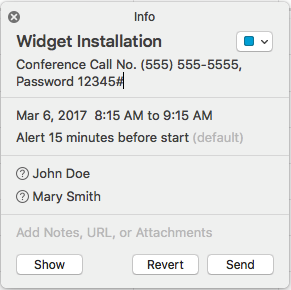
In a situation like this, it is not unusual to receive a meeting request like the one below:

Initial Meeting Request

When Mary and John accept the invitation, their calendars are populated with the above information.  Five weeks from now when they see that they have a conference call on their calendar, there is very little information that will assist them.  As a result, they may have to spend time and energy just to understand the exact purpose of the meeting.  Chances are they will likely not attend the meeting fully prepared and valuable time will be wasted.

Applying the SMART Approach

Now let’s consider what we can do to apply the SMART email approach to this meeting request.

S = Subject line:


In an email, the subject line is like the headline in a newspaper.  It should garner attention and provide the reader with an idea of what the email is about.  The same can be true of a meeting request.  Although our calendar invitation may not actually have a “subject line”, the headline should be included in the event description.   This is where you can put a few summary words that will communicate the key purpose of the meeting and provide attendees with an understanding of what will take place before opening up the calendar event.

There is also a field typically dedicated to “Location” where contact details can be included.  In a face-to-face meeting it will likely be the meeting location.  For conference calls or web meetings, it should include phone numbers, passwords or other connection instructions and information.

M = Message: Most calendar invitations have a “notes” section.  Here you should include important details for the meeting, including the agenda.
A = Action: Like emails, you want to be clear of any actions that you expect participants to take in preparation for the meeting.  For example, if Mary is to distribute electronic copies of the site map, or if we are to make inquiries with the city regarding a road closing permit, this should be clearly indicated in the notes section.
R = Response: Responses that are required before the meeting should be identified, including how the response is to be provided.
T = Time Line: The time line for the response or action requested should also be requested in the meeting request.


Revised Meeting Request Using the SMART Approach

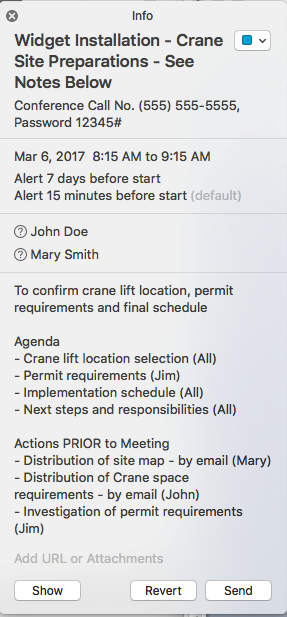
Let’s consider rewriting the meeting that we are organizing with Mary Smith and John Doe using the SMART approach.  The meeting request might look like this:

Revised Meeting Request

A meeting request of this nature provides all attendees with the information they need to be prepared and productive participants to the meeting.  Notice some actions that can be taken to make the meeting request more valuable:

  • Our Events Summary makes a reference to the notes below.
  • We have included a reminder seven days prior to the event. This can remind us to send a confirming SMART email to the meeting participants and follow up on any actions not yet completed.
  • Although we did not use this feature, in most if not all calendar programs, meeting requests can also include attachments that may be referred to in the meeting. If this is the case, refer to the attachment in the notes so that they do not get overlooked.

SMART meeting requests provide us with the opportunity to stand out from the crowd and convey our professionalism and competency.  It may take a little more time to set up, but it will save everyone time in the end.

As always, I welcome your comments and questions. You can connect with me via telephone or email or leave a comment right here on the site. And as always, please feel free to leave a link back to your own blog if you have one via the commentluv feature here on the site. If you are reading this blog post via email, you will need to locate this post on my website by clicking here. Scroll down to the bottom of the page where you will find the comment section.

Jim Baston

“When you go to meetings or auditions and you fail to prepare, prepare to fail.”

– Paula Abdul

Abstract Flow Chart

If you are engaging your field service team in business development efforts, you will be aware of the importance of having a robust and failsafe opportunity management process.  Poor processes drop opportunities, fail to keep everyone informed and generally defeat your efforts to get everyone enthusiastically involved.

In this blog, I thought it would be helpful to consider the Six Key Components of a Robust and Failsafe Opportunity Management Process for your team.

1. Clearly identify what you want your technicians to do

The process starts with having a clear understanding of what you want your technicians to do if they do find an opportunity to help.  For example, do you want them to:

  • Simply pass the opportunity over to sales (or other) for follow-up?
  • Review their ideas with the customer and get their permission for a salesperson (or other) to call?
  • Review their ideas with the customer, provide pricing, and seek the customer’s agreement to proceed?
  • Other?

2. Provide clear expectations on how you want technician to be involved in the solution

Options can include:

  • None – they leave it up to the sales team
  • Some – they provide input then back out of the process
  • Most – they work closely with the sales team (or others) to determine the final solution
  • All – they determine the final solution, price it, and present it to the customer

3. Build in flexibility to accommodate different situations

Be clear on how you want the technician (and sales team) to act as circumstances change.  Do your expectations of your field service team change depending upon the nature of the opportunity?  For example, will their actions change depending upon the:

  • Size of the opportunity?
  • Products and/or service contemplated?
  • Nature of the customer?
  • Other?

4. Define how progress on each opportunity will be communicated

Typically opportunities take time to address.  Customer visits are required, a solution must be developed and priced, customers need time to evaluate the solution, etc.  To keep the field service team engaged and enthusiastic, it is critical to keep them informed of the progress that is being made.

This also allows the technician to respond professionally in the event the customer asks a question about progress on the solution.  Having a technician respond with a flippant “I don’t know.  Those guys in the office never tell us anything”, is not helpful and certainly not professional.

5. Make it clear on who will follow up and how the follow up will take place

It is logical to place responsibility for follow up on the sales team or the person who presented the customer with the final proposal.  But, if the opportunity was quoted through sales or through another department, can the technicians play a role here?

Would it make sense to provide them with a list of outstanding proposals for each customer that they visit so that they can ask if the customer has come to some decision and perhaps provide supporting information?

I recognize that each company and each opportunity is different so this approach may not work in all cases.  However, letting a proposal to replace an old piece of equipment before it fails fall through the cracks does not help the customer if the equipment fails because they forgot about the issue.

6. Actively work to keep things on track

No system is truly failsafe for every circumstance.  Despite your best efforts, things will go wrong.  When they do, we can show leadership by addressing the underlying issues and getting things back on track quickly.

We can also address those that don’t follow the process and ensure that they understand the importance of doing so.  Failure to address problems quickly and consistently will tell everyone that the process really isn’t all that important after all.

Our technicians provide a valuable service when they take proactive actions to make recommendations that help our customers to be better off.  We can help them and help our business by ensuring that the processes we have in place work consistently and correctly.

As always, I welcome your comments and questions. You can connect with me via telephone or email or leave a comment right here on the site. And as always, please feel free to leave a link back to your own blog if you have one via the commentluv feature here on the site. If you are reading this blog post via email, you will need to locate this post on my website by clicking here. Scroll down to the bottom of the page where you will find the comment section.

Jim Baston

If you can’t describe what you are doing as a process, you don’t know what you’re doing.

– W. Edwards Deming

business-man-with-bell

December is a wonderful time of year.  But it can also be a time of high stress.  Organizations struggle to get everything done before the holidays.  Employees try to balance the surge in social commitments while continuing to take actions to meet budgets.  Systems and processes are strained by increased demands caused by weather, quotas or any other number of things.

It is a time of year when systems and circumstance combine to create a stress-fuelled environment of tension and possible conflict.  To help your field team deal with customers effectively in these stressful times, consider the following five approaches.  This will help your team maintain good relations and build higher levels of trust and remind your customers why they chose to do business with you in the first place.

  1. Connect with the customer.

Whenever stressful situations arise, it is critical for our customers to realize that they have our full attention.  We can demonstrate this by connecting with the customer.  By connecting, we mean giving our customer our full attention.  That means putting things down, standing if appropriate, exhibiting open body language[1], making eye contact and actively listening.

It is also important to show a sense of urgency in our motions and our body stance (leaning slightly forward).  Connecting with the customer in this way shows we are taking the situation seriously and interested in getting the problem resolved.

  1. Acknowledge the situation.

We can remove some of the customer’s stress and concerns by showing them that we understand.  We can do this in a number of ways.  For example, the problem being experienced is having a significant and detrimental impact on production.  We could say something like, “I can see why this is so upsetting for you, particularly given the pressures you must be facing from production to get this up and running.”  You might even say, “I can understand how stressful this must be for you, I would feel the same way, if I were in your shoes.”

Notice that I am not suggesting that we take responsibility for the problem.  We are simply acknowledging the situation that the customer is in.  This continues to build upon the trust that started when we “connected” with the customer.

  1. Explain your reasons from the customer’s perspective.

When we have to say “no”, we can explain our reasons from the customer’s perspective rather than our own.  Let’s say the customer wants us to make a temporary fix that we feel will be unsafe.  The customer is adamant that it be done and we have to say “no”.

Rather than say something like “I can’t do that.  It’s unsafe and it could get me in serious trouble.  We will have to think of something else”, it would be better to say “no” from the customer’s perspective.  For example, we could say, “Unfortunately, this suggestion could prove unsafe and I would not want to put you or your tenants in harm’s way.   There are other options that we can consider, such as …”

  1. Give the customer’s motives the benefit of the doubt.

It is vitally important that we take every customer request as a request for which they feel they are entitled to (or willing to pay for) and not an attempt to take advantage of us.  This is important because it is our perspective that will largely govern how we respond.  If we feel that the customer is “always” trying to take advantage, then our response may not be balanced and unlikely to set the stage for cooperation.

If we have the perspective that the customer is innocently asking for something that they feel they are entitled to or are willing to pay for, then our response will likely be more empathetic and geared toward establishing a foundation for collaboration.  Instead of saying, “Sorry, that’s not in the contract.  If you want me to do that, you will need to call the office and give them a P.O.”, you might consider something like, “I want to make sure that I am fair to both your company and my own.  What you are asking is not in the existing contract.  Here is what I suggest we do to get this addressed …”.

Now I know that there really are customers out there that are regularly trying to take advantage, but does it hurt to respond to them the same way as we would to a customer with an innocent request?

  1. Have alternative suggestions ready.

If we do have to say “no” to a request or tell the customer bad news, we will help keep the situation calm and provide value by having alternative suggestions ready.  Imagine a scenario where our technician tells the customer that the equipment has failed and when asked what the alternatives are simply says, “I don’t know.  I will have to look into it.”  As the customer, how comfortable would we feel about the technician’s response?  What does it tell us about the technician’s understanding of our situation?

It would be better if the technician has an answer that includes two or three alternatives that can be taken and then help us decide which option make the best sense under the circumstances.  It would be better still if the technician has made a couple of phone calls and can give even more information such as price and delivery of the various options.

December is a wonderful time of year and also one full of stress and possible conflict.  We can help our technicians through this period of stress and the inevitable interpersonal challenges that they will face with just a few simple approaches.  It is a timely gift for the month of December that can be used throughout the year.

As always, I welcome your comments and questions. You can connect with me via telephone or email or leave a comment right here on the site. And as always, please feel free to leave a link back to your own blog if you have one via the commentluv feature here on the site. If you are reading this blog post via email, you will need to locate this post on my website by clicking here. Scroll down to the bottom of the page where you will find the comment section.

Jim Baston

Stress is not what happens to us.  It’s our response
to what happens. And response is something we can choose.

– Maureen Killoran

[1] Arms uncrossed, legs comfortably apart, eye contact, etc.

If you are encouraging your technicians to take proactive steps to recommend your products and services to your customers, you may be looking for ways to help them to explore for opportunities to help.  Here are four simple steps that your technicians can take to uncover opportunities to help your customers to be better off.

1. Ask a simple question.

At the beginning or end of each maintenance service call, get your technicians in the habit of asking, “Is there anything else that we can do for you today?”  This simple question will often result in new opportunities that otherwise might go to someone else or go unfilled.

Other questions you may wish your techs to ask include, “Have there been any changes in the building/process/operations since the last time I was here?” or “Have there been any issues or concerns related to the building/process/operations since last time?”

2. Take the customer on a tour of their own facilities.

This approach was shared with me by a seasoned HVAC technician who regularly took his customers on tours.  He used it as an opportunity to showcase the work he was doing, point out equipment that was not under contract and suggest new ideas to make improvements.  His customers appreciated the opportunity to learn more about their systems and he used the time to learn more about the customers’ goals and objectives.

3. Follow up on previously quoted work.

No doubt you have several proposals that have been sent to customers that have not had any follow up.  To the best of your knowledge, no action has been taken by the customer, but you are not certain of the status.  In many cases, it will be because the customer has forgotten about them.

Encourage your technicians to speak to the customer about those outstanding proposals.  The customer will appreciate their interest and they will thank the technician if their follow-up prevented something from falling though the cracks.

4. Offer to demonstrate a new technology or software.

Technology is changing at a rapid pace and it is almost impossible for our customers to keep on top of what is going on.  When there is a technology or software that you offer that can help customers get a competitive edge, then you will be providing a valuable service bringing it to your customer’s attention.

By taking the initiative to proactively explore for opportunities to help your customers to be better off, not only will you generate more revenues, but your technicians will actually be delivering a higher level of service.  Your customers will appreciate the added attention and see great value as you help them achieve their business goals.

As always, I welcome your comments and questions. You can connect with me via telephone or email or leave a comment right here on the site. And as always, please feel free to leave a link back to your own blog if you have one via the commentluv feature here on the site. If you are reading this blog post via email, you will need to locate this post on my website by clicking here. Scroll down to the bottom of the page where you will find the comment section.

Jim Baston

“I learned that you don’t get anywhere by sitting comfortably in a chair.”

 – Conrad Hilton

One of your technicians has just made a recommendation on a critical piece of equipment.  It is old, parts are hard to find and a failure will have catastrophic results. The customer hesitates and says something like, “Leave it with me and let me think about it.”  Underlying this statement could be an objection.  It is for times like these that it makes sense to help your technicians have the skills/tools ready to (or be prepared to) handle customer objections.

You might be wondering why I am using sales terminology when I insist that the technician’s act of making recommendations is not a sale but a service.  It is because in situations like these letting the matter go without investigating the customer’s reason for their hesitation does not fulfill our obligation to serve the customer in the best way possible.  Let’s examine why.

Why the customer may hesitate

The customer may hesitate for several reasons.  Perhaps they really do want to think about it, do the math and make a financial determination and that will take time.  Perhaps they need the approval of someone else or have another company that they would have do the work.  Maybe they are sceptical of the solution or don’t fully trust the technician. Or maybe they do not fully understand the risk of not taking action or the benefit of moving forward and therefore cannot make a fully informed decision.

Regardless, if the stakes are high, then the technician should be prepared to explore the cause of hesitation further and try to address their concerns if appropriate.  By not doing so, they are letting the customer make a choice that he/she may later regret and they certainly won’t thank us if they do.  And, it certainly won’t be helpful if we say something like, “You should have listened to me when I told you to …” when things do go as the technician predicted.

What we can do

  1. Ensure your technicians are aware of and expect that the customer may have concerns about any recommendation.
  2. Help your technicians be prepared to explore any concerns and have a plan to address them if they do arise.
  3. Have a backup plan if the technician is unsuccessful.

“Do you mind if I ask the reason for your hesitation?”

Let’s go back to the example of an imminent equipment failure.  The risk to the customer is high and yet they may say, “Leave it with me and let me think about it.”

Keeping in mind that the customer may genuinely wish to think about the issue, your technician can ask a simple question to help them get to the underlying concern.  “Do you mind if I ask the reason for your hesitation?” Chances are, the customer will answer this question with underlying cause for their hesitation.

By exploring the apparent concern of the customer, the technician will be in a better position to help the customer assess the recommendation and make a more informed decision.

Here are just a few examples of what to expect:

  • Hesitation based on scepticism: “My last service company never mentioned this” (often happens when you win a contract from a competitor and the technician has not had time to build trust) or “You guys have been looking after my equipment for the past 10 years, how come you’re just bringing this up now?”
  • Hesitation based on current buying habits: “I already have a company that can do that work for me.”
  • Hesitation based on uncertainty: “I am not sure if it will …”
  • Hesitation based on pricing and/or budgets: “We don’t have any reserve in the budget.”

With these examples in hand, you can help spend some time during your safety/service meetings with your technicians to help them develop a professional response to each of them if they do arise.  The customer may still say “no” despite your technician’s best efforts but at least the decision will be a better informed one.

Have a back up plan. 

What if the technician was unable to deal with the customer’s underlying concern and the matter is of some urgency?  An equipment failure for example could be catastrophic.  Should they push harder?  My answer is that they should not.

However, they should not drop the matter either.  I suggest that you have in place a process where in these circumstances, the technician can alert management so that a responsible follow-up with the customer can be taken by the manager or the sales team.

As always, I welcome your comments and questions. You can connect with me via telephone or email or leave a comment right here on the site. And as always, please feel free to leave a link back to your own blog if you have one via the commentluv feature here on the site. If you are reading this blog post via email, you will need to locate this post on my website by clicking here. Scroll down to the bottom of the page where you will find the comment section.

Jim Baston

“He who hesitates is last.”

 – Mae West

I recently read Daniel Pink’s book, Drive – The Surprising Truth About What Motivates Us, and found that the conclusions from the book are directly relevant for those managers who are looking for ways to encourage their technicians to proactively promote their products and services.  These conclusions made me question, “Is it time to stop paying technicians for leads?”

Extrinsic vs. Intrinsic Rewards

In Drive, Pink presents compelling evidence that extrinsic rewards for completing certain tasks – for example, external rewards such as commissions, lump sum payments, etc. – do not always work and can even cause harm.  According to Pink, this is particularly true where the task is not routine and when it entails thinking and creativity.

The evidence suggests that creative tasks, such as evaluating and presenting the best solution for addressing a particular need, provide their own rewards in the doing.  These are called intrinsic rewards because the reward comes from performing the task rather than from an external source.  In situations like these, it is the reward of actually completing the task itself that largely motivates the employee to continue.

This last point is consistent with what I have experienced in my work with technicians.  There are many field service professionals who naturally bring ideas to the customer without any prompting or incentives.  They do this because they see it as part of the service they provide.  They get satisfaction and take pride from the fact that they are truly helping the customer.  They don’t need extrinsic rewards to get them to act; their reward comes from the act itself.

The Problem with Extrinsic Rewards

The problem with extrinsic rewards is that they can diminish intrinsic motivation for doing a task and turn that task from an interesting part of the job, into a menial chore.  But that is not all that Pink found to be problematic about extrinsic rewards.  Diminishing intrinsic motivation is just the first of the “Seven Deadly Flaws”[1] as described by the author.  The other six flaws of extrinsic rewards are:

  1. They can diminish performance.
  2. They can crush creativity.
  3. They can crowd out good behaviour.
  4. They can encourage cheating, shortcuts and unethical behaviour.
  5. They can become addictive.
  6. They can foster short-term thinking.

What Can Be Done?

So, what can we do if we want to encourage this proactive behaviour on the part of our technicians?  Here are some ideas:

  • Ensure that the baseline compensation is fair and adequate.
  • Constantly reinforce the fact that the act of identifying opportunities to help and speaking to the customer about them is an integral part of the service provided. As part of this, showcase examples of where technicians have acted in this way and how it specifically has helped the customer.
  • Openly praise and provide feedback to reinforce desired behaviours.
  • Offer rewards that are not contingent on the individual act of promoting services, but which recognize group-wide achievement. Pink calls these types of rewards “now that” rewards – as in, “now that you have achieved this, here is a reward to recognize that achievement.”  These are rewards that are not typically communicated in advance.  Pink cautions that this approach can lose its effectiveness if the “now that” rewards become expected (or contingent) rewards.

In the end, I think it all comes down to how we think about the task of making recommendations to customers.  If we see this task as part of the service, then we should treat and support it like we do all other services.  If we don’t provide extrinsic rewards for completing routine repairs for example, does it really make sense to do so for making recommendations?  The evidence suggests that offering extrinsic rewards may have the opposite effect to what we intend.

As always, I welcome your comments and questions. You can connect with me via telephone or email or leave a comment right here on the site. And as always, please feel free to leave a link back to your own blog if you have one via the commentluv feature here on the site. If you are reading this blog post via email, you will need to locate this post on my website by clicking here. Scroll down to the bottom of the page where you will find the comment section.

Jim Baston

“Motivation is the art of getting people to do what
you want them to do because they want to do it.”

 – Dwight D. Eisenhower

[1] Daniel H. Pink, Drive – The Surprising Truth About What Motivates Us (New York:  Riverhead Books, 2009), p. 59.

Your field service team can add tremendous value to your service relationships when they recommend products and services that you can provide that will help your customers be better off.  They are in a unique position to do this; they have the knowledge of the technology, an inside understanding of your customer’s current processes and equipment and, hopefully an appreciation of your customer’s goals and objectives.  They also have proximity to the customer.  The question is however, if you engage your technicians in promoting your services, do you tell your customers?

Do You Tell Your Customers?

I recently spoke at the Field Service Forum in Amsterdam.  I asked how many of the attendees either formally or informally encouraged their technicians to proactively recommend their services to their customers.  About 60% of the room raised their hands.  I then asked how many of those who raised their hands told their customers that they were engaging their technicians in this way and not a single person responded that they did.  This is entirely consistent with other discussions that I have had.

How about you?  Do you tell your customers?  Do you tell them that you are encouraging your technicians to look for products and services to recommend to them?  If you are not, you are missing out on an important opportunity.

Why Not?

Let’s examine one of the reasons why we seem so hesitant to let our customers know about the promotion of products and services by our technicians.  I believe that underlying our reluctance is that we tend to see the actions of our technicians as a “selling” activity.  And, it’s hard to promote “selling” as a benefit to our customers.

Where is the value for the customer in a conversation that goes like this?  “Mr./Mrs. Customer, I want you to know that we have encouraged our technicians to look for opportunities for us to sell you more services so that we can increase the revenues we receive from you.”  It’s hard to see any value in this statement, regardless of how noble our intentions or those of our field service team are.

Remember, It is a Service

The key is to keep in mind that we want our technicians to use their expertise and proximity to look for opportunities to help the customer and raise these with the customer when they find them.  This is valuable because the actions of our technicians can truly help our customers to be better off and to achieve their business goals.  Their recommendations therefore, are a service.

Yes, as service providers, we do benefit from this proactive activity through increased service revenues, but those revenues are our reward in return for the value of the service that we provide.  By regarding the proactive activities of our technicians through a service lens, it becomes easier to promote their activities just like we would any other service that we provide.

Have this Conversation with your Customers

An excellent way to promote the proactive actions of our technicians is to have this conversation with our customers.  “Mr./Mrs. Customer, we have provided direction and training to our technicians to encourage them to look for opportunities to help you operate your facility/processes more effectively while they are performing the service.  Would you have any objection when they find something that will help you achieve your business goals, if they bring the opportunity to your attention?”

By explaining the actions of our technicians in this way, we are able to communicate the value of their efforts for the customer.

If you formally or informally engage your technicians in business development activities, I encourage you to tell your customers – and let them know why it is of value for them.

Promote their efforts to your customers as a point of difference.  Let them know that you are providing your “heads” as well as your “hands”.  When they recognize the value of these efforts and benefit from the resulting recommendations, they will be delighted that you have engaged your technicians in this way.

As always, I welcome your comments and questions. You can connect with me via telephone or email or leave a comment right here on the site. And as always, please feel free to leave a link back to your own blog if you have one via the commentluv feature here on the site. If you are reading this blog post via email, you will need to locate this post on my website by clicking here. Scroll down to the bottom of the page where you will find the comment section.

Jim Baston

“You are not here merely to make a living. You are here in order to enable the world to live more amply, with greater vision, with a finer spirit of hope and achievement. You are here to enrich the world, and you impoverish yourself if you forget the errand.”

– Woodrow Wilson