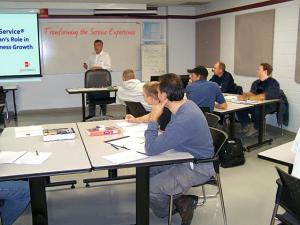
 Service managers often ask me if they should attend our Proactive Service® workshop with their technicians. My answer is always “yes” and I explain ways to get the most out of training their service tech team. Although I am enthusiastic about the manager attending, this is a somewhat qualified response because these benefits of attending can be outweighed by how the manager acts during the workshop itself. Too often, I find the manager in the back corner of the room, huddled over their laptop or frantically texting someone on their phone. Frequently they will leave the room for long periods of time. To me, this is a lost opportunity and can actually have a negative impact on the training. Here are the 6 ways to participate effectively and get the most return for your training investment: Read more
Tag Archive for: service technician training
 I tried to make an appointment last Monday to take my motorcycle in for the end of season oil change and instead I learned the 6 steps on how to use the telephone to turn away business. I thought it might be helpful to share it with you.
Step 1: Put callers on hold for long periods. I realize that this is not a new revelation, but I am amazed that, with the technology available today, some companies are able to persist in putting people on indefinite hold. All it took for me was to ask for the “service department”. After what seemed like several minutes, the receptionist returned to the line and said, “I can’t seem to find him anywhere! Would you like to leave a voicemail?” Which brings me to Step 2 of using the telephone to turn away business.
Step 2: Don’t be available – especially if you are in the “service” department. I have no idea where the service manager/advisor was (and apparently I was not the only one), but not having anyone who can handle a service call in the middle of the day is one sure way to let the customer know that you do not believe they are important.
Step 3: Don’t return your calls. No matter what, don’t call the customer back – certainly not on the same day! Prompt responses to voicemail messages only serves to encourage more customers to leave more messages that might result in more business.
Step 4: Make sure you are able to set your phone system so that callers cannot reach a live person during busy periods. This is especially important to screen out angry callers who want to know why you haven’t responded to their voicemail. This particular system would not let you dial “zero” to reach a live person. You could only dial “1” for service, “2” for sales, “3” for … (Refer to Step 2).
Step 5: Encourage your staff to talk negatively about the company. This is a particularly good one and highly recommended if you are serious about reducing the number of pesky customers. In my case, after several attempt at reaching the “service” department (Press “1”), I decided to try to reach a salesperson (Press 2). It worked! A rather unenthusiastic voice announced “Sales” and asked how he could help. I explained to him that I was trying to reach the service department and was unable to get any response. I asked if he could see anyone. “Hang on” he replied and put me on hold. (See Step 1), “I found him, but he is on the phone,” came the eventual reply (See Step 2). I told him that I thought his phone system was terrible. “Yes!” he agreed. “It’s not been the same since we got the new system last year. We keep telling the boss that it sucks but he won’t listen.” This was the first bit of enthusiasm I could detect in his voice. He obviously took Step 5 seriously.
Step 6: Tell people how busy you are. This assumes that you failed at Step 2 and the persistent caller finally manages to break through your defenses. I finally got through to the service advisor/manager at about 4:55 that evening – I had been trying since 9:00 am. I explained who I was and that I had left a voicemail message early that morning. “Oh yeah! I got your message and you’re 23 on my list to call back. What do you need?” (“What do you need?” is industry jargon for “How may I help you?”). I repeated the information that I left on the original voicemail – that I would like an oil change and hoped to be able to schedule it for Thursday morning and that I would like to wait. “What time do you have available?” I inquired. “What time do you want to bring it in?” he responded. “Early, if possible.” I replied. “Well, we’re wide open so name the time.” Wide open? How could they be so quiet and yet be so busy?
And then it hit me. Their strategy was working! Use the telephone to turn away business and get rid of those pesky customers who only end up making the job more complicated. I started to wonder if service manager/advisor and everyone else were really busy at all, or were they just pretending they were as part of the strategy (Step 6).
Now, I should explain that the manufacturer of the motorcycle I ride has only one authorized service centre in my area so, unless I am prepared to ride a considerable distance, I don’t have much choice on where I take my bike for service. Given the experience I just had, I don’t imagine that this will be a problem for very long.
How about your organization? Are you turning away business too?
I’d love your feedback! And as always, please feel free to leave a link back to your own blog if you have one via the commentluv feature here on the site. If you are reading this blog post via email, you will need to locate this post on my website by clicking here. Scroll down to the bottom of the page where you will find the comment section.
Jim
“A customer is the most important visitor on our premises, he is not dependent on us. We are dependent on him. He is not an interruption in our work. He is the purpose of it. He is not an outsider in our business. He is part of it. We are not doing him a favor by serving him. He is doing us a favor by giving us an opportunity to do so.”?
– Mahatma Ghandhi
 In the last blog post, we talked about the 2nd step in creating a Proactive Service® culture or focus for your field service team. The 3rd step is to provide them with continuous educational opportunities about your products and services. We often assume that our staff knows more about what we do as a company than they actually do. In fact, in many cases, our technicians’ lack of knowledge is actually holding us back and negatively impacting our bottom lines.
In our work with training technicians to be more proactive in business development activities, we ask them to list all of the products and services that their company offers. We usually get two, three and sometimes as many as four sheets of flip chart paper filled with products and services. We then ask them’ “How many of your customers know that you do all of these things?” “Very few, if any” is the usual answer.
We then ask the technicians, “How many of you know enough about all of the services and products that your company offers to have a high-level conversation with your customers about what you do?” Several, if not all of the technicians typically will indicate that they are not aware of all of the products or services offered. We then ask, “If you were more aware and were able to carry on that high-level conversation to explore if the customer could benefit from the product or service, do you think that you would be of more value to that customer?” The answer is invariably “Yes!” “So what are you prepared to do about it?” is our challenge.
Now we have had many discussions with both technicians and their managers about who is responsible for their learning about the capabilities of the company. Is it up to management to educate their technicians or should the technicians make it a point to educate themselves? Regardless of where you sit on this question, you will do your customers, technicians and yourselves a great service by taking the initiative in educating your technicians on your products and services.
Take every opportunity to educate your technicians about your products and services. Ensure they know the value of each one and how your customers will benefit. Help them understand what to look for to determine if there is an opportunity to help and encourage them to speak to your customers about these services when they think that they will benefit. Doing this will ensure your team knows the complete range of services you offer and give them more confidence to engage the customer. This will allow your technicians to offer a higher and more valued level of service. Your customers – and your technicians – will thank you.
I’d love your feedback! And as always, please feel free to leave a link back to your own blog if you have one via the commentluv feature here on the site. If you are reading this blog post via email, you will need to locate this post on my website by clicking here. Scroll down to the bottom of the page where you will find the comment section.
Jim
“An investment in knowledge pays the best interest”
– Benjamin Franklin
 In the first blog in this series, we talked about the first step to create a Proactive Service® focus for your field service team. The second step involves encouraging them to get to know your customers’ business goals. At first glance this may seem a bit off of the beaten path of the technical nature of their job, but it is critical in providing a higher level of service. A technician who understands the business goals and challenges faced by the customer will be attuned to opportunities to help their customers achieve them.
Without knowing the goals of the customer, how can our technicians make valuable recommendations? A solution that works for one company might be contrary to the needs of another. There is a wonderful story circulating around the Internet that illustrates the danger of solving problems without understanding the business goals. Perhaps you have read it. It goes something like this. Read more
 If you are interested in creating a proactive service® focus for your field service technicians, the first step is to focus on the service, not the sale. This is more than just semantics, it is a mindset that deals with the very heart of what we want our technicians to do.
Technicians who seem naturally gifted at selling their company’s products or services do not see their efforts as selling at all – they recognize their recommendations as the valuable service that they are. To them it is a service activity. Read more
 Creating a Proactive Service® culture throughout your service team is one of the most effective ways that a service company can grow their business and create a distinctive competitive advantage. By Proactive Service®, we mean a technical service team that is engaged not only in maintaining and fixing equipment to the highest levels, but in actively looking for ways that their firms can help their customer meet their own business goals. It is proactive because the technician takes the initiative to identify opportunities to help and proactively addresses these with the customer. Read more