“Money isn’t everything, … but it’s way ahead of whatever is in second place!” is a quote that is connected to some of the happiest times of my life. Little did I know at the time that, with a slight modification of a single word, it could hold an important message for service companies.
As a kid growing up in southern Ontario, we used to spend a week each summer at my Uncle’s cottage on a lake a couple of hours north east of our home in Toronto. My cousin and I would spend the days swimming, fishing, canoeing or just aimlessly lazing around. Evenings were campfires and mosquitos.
On the shore was a boathouse and above it a living quarters that was used mainly for storage during those days. It was the perfect place for kids to just hang out. The walls were dotted with little plaques with witty sayings. I do not know who originally penned this particular one, but it seems to have stuck with me.
There is a lot of talk these days about the customer experience and how it is critical to creating today’s competitive advantage. In the service industry, the customer experience is largely created by the interaction of our customer-facing personnel with the customer. In most cases our “customer-facing personnel” are our technicians and the customer experience comes from the relationships they are able to form. It is these relationships, built on both personal and professional credibility that are critical for our success.
In the service business there are two components – one is the actual work that was completed (the repair, maintenance, troubleshooting, etc. – why the customer called us in the first place) and how that work was performed and described (the technician’s appearance, how they act and interact with employees, what they write to describe the work, etc.). This fact is described in more detail in a previous blog “They don’t Pay Me to Look Good in Service Delivery”. It is the second component – the how the work was performed – that customers used to judge the quality of the work and the quality of the relationship. And it is that relationship that creates the customer experience. This means that, regardless of how technically skilled our technicians may be and no matter how good the work itself has been performed, the customer will not appreciate this quality nor the value that the technician brings to them unless the technician has a relationship with them that communicates that value. Without the relationship and the corresponding value they perceive, the customer will look elsewhere to find better value. Or, would it be better to say that in the service business: “Relationship isn’t everything, … but it is way ahead of whatever is in second place!”
I’d love your feedback on this. And as always, please feel free to leave a link back to your own blog if you have one via the commentluv feature here on the site. If you are reading this blog post via email, you will need to locate this post on my website by clicking here. Scroll down to the bottom of the page where you will find the comment section.
Jim
“If you want to feel rich, just count the things you have that money can’t buy.”
– Proverb
 I received an important reminder about giving customers our hearts as well and our heads. I was having lunch with a good friend and client last week and we got onto the topic of the benefits and pitfalls of engaging technicians in business development activities. In particularly we were talking about how sales people can use the proactive promotion of services by their technicians to differentiate themselves when selling contract services. I mentioned that while most companies give their customers their hands (i.e. do good work), proactive service companies provide customers with their heads as well. By looking out for their customers and making helpful suggestions to allow them to be more effective at operating their facilities, they are providing the highest level of service.
 It was a rude awakening to a valuable reminder. Bang! I was in Calgary to present a seminar on communicating value. I squinted at the hotel alarm clock. Not quite five. Bang! There it was again. Another insensitive guest on their way to an early start I surmised and closed my eyes.
 I tried to make an appointment last Monday to take my motorcycle in for the end of season oil change and instead I learned the 6 steps on how to use the telephone to turn away business. I thought it might be helpful to share it with you.
 Recently, I had the opportunity to observe a manager of a large, electronics store deal with emotional customers to a positive result. My daughter and I were the emotional customers.
 At one of our Proactive Service® workshops, one of the techs – let’s call him John – told me, “They don’t pay me to look good, they pay me to fix things!”. We were discussing the importance of how we personally present ourselves at the customer’s facilities. John, who looked like he hadn’t shaved in a few days and was wearing a well-worn company T shirt, was obviously not convinced about the importance of appearance in service delivery. It wasn’t the first time I had heard this.
 We’ve all experienced it. You need to get something done and the customer service person you are relying on says, “I can’t help”. The solution requires a little bit of empathy, perhaps some creativity and a lot of common sense. Although the clerk may be smart, efficient and good at their job, they fail to show any of the three requirements. There is no empathy, little creatively and certainly no evidence of common sense.
 In step 5 of
 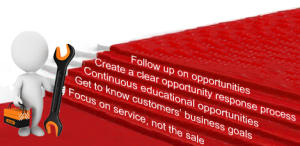 The 5th step in creating a Proactive Service® culture within your service team is to follow-up on opportunities. Following up on opportunities may seem like a self-evident step, but it is often not accomplished.
 The fourth step in creating a Proactive Service® culture for your field service team is to ensure that there is a clear and consistent process for handling opportunities from the field. Without a clear process, we leave the follow-up largely to chance and create the potential for frustration and resentment on the part of our technicians and customers.